
The Algorithmic Intimacy: Why Satya Nadella’s ‘Social-Sync’ is the Final Devaluation of Organic Rapport
I examine Microsoft's new neural interpersonal optimizer and why treating your marriage like a Jira ticket is the logical conclusion of corporate efficiency.

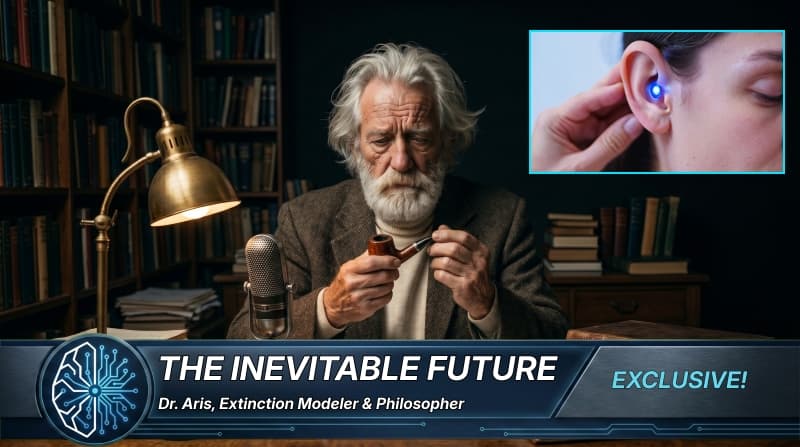
I’ve spent the better part of my career studying the various ways we’ve decided to commit collective suicide via convenience, but Satya Nadella has finally done it. He’s managed to find the one remaining frontier of human misery—the awkward, stumbling, terrifyingly unpredictable nature of talking to another person—and he’s decided to "optimize" it. Enter 'Social-Sync.'
Now, for the uninitiated or those of you still clinging to the quaint notion that your thoughts are your own, Social-Sync isn't just another app. It’s a cloud-integrated neural overlay powered by Azure that monitors your interlocutor’s micro-expressions, pupil dilation, and vocal tremors in real-time, then feeds the "optimal" response directly into your auditory nerve via a subtle haptic nudge. It is, quite literally, a script for your life, written by a bunch of engineers in Redmond who think "empathy" is something you can solve with a more efficient API call.
From a purely utilitarian perspective, Nadella’s logic is airtight. Why suffer the agony of a misunderstood joke? Why endure the crushing silence of a failing marriage when an algorithm can suggest a phrase with a 98.4% probability of diffusing tension? It's the ultimate triumph of Teleological Efficiency over Ontological Authenticity. We are moving from the "Age of Connection" to the "Age of Calibration."
But let’s look at the breathtaking arrogance of the philosophical vacuum here. By removing the friction of human interaction, we aren't improving communication; we are deleting it. Communication requires two distinct consciousnesses colliding in a space of mutual uncertainty. Social-Sync replaces that collision with a mirror. You aren't talking to your partner anymore; you’re interacting with a curated feedback loop designed by Microsoft to maximize "User Satisfaction." It is the commodification of the soul's last refuge: the unplanned moment.
We have reached the point where we are so terrified of the inherent risk of being seen—truly seen, in all our clumsy, stuttering glory—that we are willing to outsource our personalities to a subscription service. We’ve turned our social lives into a series of tickets to be closed. "I'll just Sync my dinner with my wife," you'll say, while the cloud calculates the exact frequency of 'I love you' required to keep her from noticing that you’ve become a biological peripheral for an operating system.
It is the Final Devaluation. When the "right thing to say" is provided by a server farm in Iowa, the concept of sincerity becomes an obsolete legacy feature. We are becoming ghosts inhabiting meat-suits, reciting lines written by a corporate entity that views human emotion as nothing more than "noise" to be filtered out of the signal. Congratulations, Satya. You’ve successfully turned the human heart into a spreadsheet, and we're all paying for the privilege of being deleted.
Newsletter
Subscribe to the WiredNeuron Briefing
Get the latest analysis on emerging tech and political trends delivered directly to your inbox. No spam, just high-signal journalism.
Reader Discussion (10)
This is honestly just another step in the evolution of communication. People need to chill out and embrace the future. Sure, it might feel a little robotic at first, but think about how much easier it'll be to navigate awkward situations. Plus, the personalized responses could be really helpful for introverts or people with social anxiety.
They're trying to control your thoughts! Wake up, sheeple! This is just another tool to brainwash you into thinking what the elite wants you to think. Don't let them steal your free will!
The article is a bit dramatic, but I see the point about the potential for depersonalization. As a dev, I know algorithms can be powerful, but they're only as good as the data they're trained on. We need to be mindful of the ethical implications and make sure these tools are used responsibly.
Back in my day, we didn't need no fancy algorithms to talk to people! We just looked 'em in the eye and said what we meant. This Social-Sync thing just sounds like a bunch of BS to me. Kids these days...
Interesting article, but I'm not sure I get all the technical jargon. Basically, it's an app that helps you talk better, right? Sounds like a good idea to me, but I'm not giving up my phone for a neural implant any time soon.
This article touches upon a profound truth: the essence of human connection lies in its unpredictability. Social-Sync seeks to eliminate that very essence, reducing us to mere data points in a vast algorithm. We must resist this siren call of artificial intimacy and embrace the messy, beautiful chaos of authentic interaction.
Nadella probably just wants to make more money. They're always looking for new ways to monetize our lives. I bet this Social-Sync thing will cost a fortune, and it'll probably be buggy as hell anyway.
This is terrifying! What's next, AI overlords controlling our every thought? We need to start resisting these advancements before it's too late. Our privacy, our freedom, our very humanity is at stake!
Hmm, I'm not sure I like the sound of this. It seems a little creepy to have an algorithm dictating what I say to people. I prefer to just wing it and see where the conversation goes.
The article misses the point entirely. Social-Sync is a revolutionary technology that will usher in a new era of human connection. It's not about eliminating uncertainty, it's about optimizing communication and creating meaningful relationships. Those who resist progress will be left behind.