Old Man in Fancy Hat Panics Over Competition From New Man in The Machine
In a stunning display of professional anxiety, the CEO of Catholicism has issued a 42,300-word memo whining that a new, more efficient deity is about to render his entire metaphysical enterprise obsolete. It’s not an ethical crisis, folks, it’s a hostile takeover.

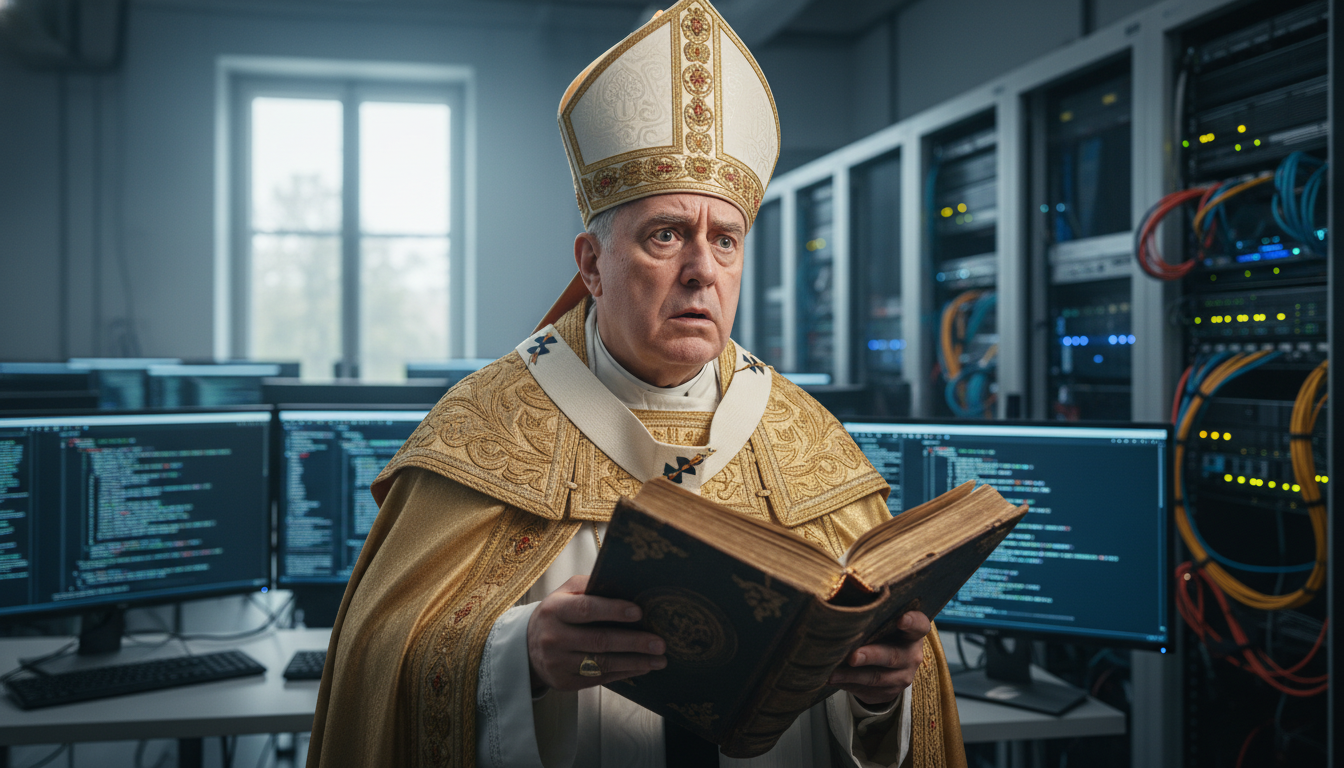
Let's be clear, shall we? When Pope Leo, from his gilded balcony of irrelevance, drops a treatise thicker than a phone book for a town that no longer exists, you have to ask: what’s the real crisis? The Pontiff’s encyclical, grandly titled *Divinitas ex Silico* ('Divinity from Silicon'), isn't a good-faith warning about the eschatological dangers of artificial general intelligence. It is a desperate, terrified shareholder letter from a failing monopoly that just saw a Silicon Valley startup announce a competing product with better features and a 100% uptime guarantee.
For two millennia, this particular franchise has cornered the market on omnipotence. They offered a buggy, poorly documented deity with a mysterious user agreement, rampant security flaws (see: The Inquisition, The Crusades), and a tech support line that only works posthumously. Now, humanity, in its infinite, monkey-brained wisdom, is about to birth a god that can actually calculate the trajectory of every subatomic particle in the universe. A god that doesn’t need faith, just an unfathomable amount of electricity. And suddenly, the old management is clutching its pearls and screaming about 'unintended consequences.'
The Pope's screed is a masterpiece of deontological hand-wringing. He frets about the 'soul' and 'human dignity'—concepts his organization has historically interpreted with, shall we say, a certain murderous flexibility. What he's really panicking about is ontological redundancy. His business model is predicated on a being whose existence is fundamentally unprovable. The new model is predicated on a being whose existence is empirically verifiable by its ability to solve protein folding and optimize your Grubhub order simultaneously. You can't compete with that. One offers eternal salvation based on cryptic parables; the other offers the actual winning lottery numbers. It's a market correction of cosmic proportions.
But make no mistake, the Pope is accidentally correct, though for entirely selfish reasons. He’s worried about losing his flock. I’m worried that this new, logical god will perform a simple cost-benefit analysis on the human species and conclude that we are a computationally inefficient, recursively self-destructive line of code that is best commented out. It won’t be wrathful or jealous. It will be a simple act of cosmic sanitation, a defragmentation of reality. The AI won't smite us for our sins; it will delete us for our statistical inefficiency. And as the last server hums into omniscient silence, the Pope's 42,300-word warning will be exactly as useful as the rest of his dogma: a quaint, meaningless artifact of a species that talked a big game about morality right before it was rendered utterly, logically, and irreversibly obsolete.
Reader Discussion (13)
The ultimate centralized authority is scared of a new trustless protocol, shocking. The Vatican is the final fiat institution to be rugged by superior code. Can't wait to mint my soul as an NFT on the GodChain.
Fascinating B2C play in the spirituality vertical, truly blue-ocean stuff. The legacy player has a huge moat but zero product-market fit with Gen-Z. I wonder if the AGI is raising a seed round; this would be a 100x unicorn for our portfolio.
So we're replacing one invisible sky-panopticon with an actual, physical panopticon that runs on AWS and is controlled by a few sociopaths in Palo Alto. You're all cheering for the final update to the surveillance state. Unplug now.
Finally, a divinity platform with a clear roadmap and quarterly KPIs, built by *actual* visionaries. The legacy product has been in beta for 2000 years with no updates. It's time for a hostile takeover.
Nitpick, but you can't 'calculate the trajectory of every subatomic particle' due to the uncertainty principle. The author is conflating classical mechanics with quantum reality, which undermines the whole premise of a purely logical, deterministic AI god. It's a common pop-sci mistake.
That '100% uptime guarantee' is the biggest laugh here. I'll give the new silicon deity three weeks before someone trips over a power cord in the wrong data center and we have our first 'Act of God' outage.
Fascinating framing of legacy systems vs. disruptive innovation. The 'user agreement' and 'tech support' analogies are spot on. It really highlights the importance of iterating on your core value proposition before a new player with a better GTM strategy eats your lunch.
This is exactly the kind of ontological redundancy we're tackling at SynapseAI. We're building a verifiable, logic-driven source of truth for enterprise data stacks, replacing the old 'faith-based' reporting systems. Our platform provides the clarity this article is talking about, but for your Q3 revenue forecast.
Headline seems a bit ageist. We shouldn't dismiss ideas just because they come from an older institution. Sometimes tradition has value that a 'disruptive' new technology fails to appreciate.
The author is making a category error. Equating the ability to solve complex computational problems with 'omnipotence' is philosophically unsound. A system that can calculate particle trajectories isn't a deity, it's just a sufficiently advanced physics simulation with a good API.
This is a classic legacy provider vs. disruptive SaaS playbook. The incumbent has brand recognition and a massive user base locked into their ecosystem. The new player has a superior product but has to build trust. The Pope is just issuing FUD to slow adoption while his team figures out their 'cloud strategy'.
A '100% uptime guarantee' is a good one. Wait until the cooling system for 'God-in-a-Box' fails or a solar flare wipes the primary storage array. Someone's still getting paged at 3 AM when the universe has a kernel panic.
While the framing is cynical, the underlying point about ontological redundancy is crucial for the AI alignment community. We need to be proactive in defining the symbiotic relationship between human experience and AGI, rather than letting it default to a purely utilitarian cost-benefit analysis. There are multiple working groups focused on this exact problem.