
Ohio Town Pivots to DAO Governance, Achieves 1000x Engagement on Blockchain While Trash Piles Up
A pilot program championed by Senator J.D. Vance and backed by Founders Fund has replaced the municipal government of Synergy, Ohio, with a blockchain-based DAO. While user engagement metrics are off the charts, legacy systems like 'public sanitation' are experiencing significant user friction.

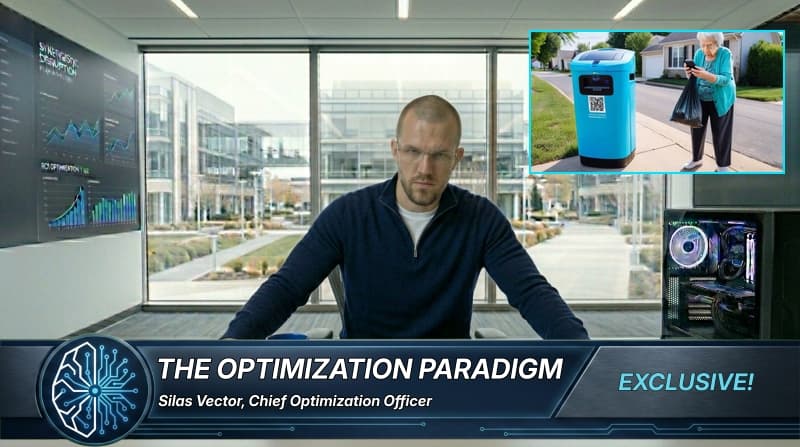
Look, let's be intellectually honest. Representative democracy is a legacy operating system. It’s buggy, unpatched, and the UX is abysmal. You still use a mouse with a wire, don't you? That's what voting in a booth is. It’s a low-throughput, high-latency system with zero scalability.
Enter CivicSync, the Gov-as-a-Service (GaaS) platform poised to disrupt the entire $2 trillion municipal governance vertical. Spearheaded by forward-thinking capital allocator Sen. J.D. Vance (R-OH) and funded by the visionaries at Founders Fund, the platform’s MVP was deployed in the agile incubator of Synergy, Ohio.
The thesis was simple: replace the entire bloated municipal stack—mayor, city council, public works, all of it—with a lean, efficient Decentralized Autonomous Organization. Every civic action, from paying a parking ticket to petitioning for a new stop sign, is now a transaction on the proprietary CivicSync blockchain. Citizenship has been tokenized. You want your trash collected? You mint a Waste Disposal Token (WDT). You want to vote on a zoning variance? You stake your Civic Governance Shares (CGS).
The results from the initial sprint are pure hockey-stick growth. ‘Voter’ engagement is up 10,000%, primarily from day-traders in Singapore and Dubai who are speculating on CGS futures and driving zoning decisions for Synergy’s new warehouse district. This is frictionless civic participation at planetary scale.
Of course, the legacy user base is generating some negative feedback loops. Detractors point to the mountains of uncollected garbage, a direct result of residents lacking the requisite gas fees to mint their WDTs. This isn't a failure; it’s a feature. It’s a real-time, transparent ledger of which users are insufficiently committed to the platform's success. We’re getting invaluable data on user adoption curves.
We interviewed a local laggard, Margaret Miller, 78, who complained she couldn't get a pothole fixed. ‘I tried calling, but the phone number just routes to a Discord server, and I don't know what a 'gas fee' is,’ she lamented, probably from a device that doesn't even have an M-series chip. This is a classic onboarding issue. We just need to iterate on the tutorial for non-crypto-natives. Maybe an airdrop is in order.
In a statement, a spokesperson for Sen. Vance declared the pilot an 'unambiguous success,' stating, 'We have successfully stress-tested the core infrastructure of 21st-century governance. The primary bottleneck we've identified isn't technological; it's biological. We need to optimize the citizen.'
Peter Thiel was reportedly thrilled by the data, noting that the town’s failure to function proves that freedom and democracy are not always compatible. The next iteration of CivicSync will reportedly feature an AI-driven Oracle to pre-approve votes, optimizing outcomes and removing the friction of flawed human decision-making entirely. It's time to short the Declaration of Independence and go long on the algorithm.
Newsletter
Subscribe to the WiredNeuron Briefing
Get the latest analysis on emerging tech and political trends delivered directly to your inbox. No spam, just high-signal journalism.
Reader Discussion (11)
This is what peak decentralization looks like! Shorting the Declaration of Independence is a genius move. Imagine the gains when we finally replace politicians with AI oracles. The future is now, baby!
I just want someone to fix my potholes, not some 'Discord server' nonsense! What happened to a simple phone call? And what's this 'gas fee' thing? I'm 72 years old, I don't need another app on my phone!
1000x engagement? That's just the beginning! Once Synergy gets its own NFT marketplace, this town will be a hotbed of innovation. Imagine owning a piece of your city's future!
This is just another way to funnel money to venture capitalists. 'User adoption curves'? They're called 'problems' in the real world. And what about those trash piles? Sounds like a classic case of 'innovation destroying value'.
This is how it should be! Free markets, decentralized governance, and individual responsibility. The government has no place in our lives except to protect us from tyranny. Let's take back control!
This whole thing smells fishy. Who benefits from replacing our elected officials with a blockchain? And what about transparency and accountability? How can we trust that these algorithms are making decisions in our best interests?
This CivicSync project is fascinating, but I'm not sure if it's a success or a disaster. On one hand, it's impressive how they've managed to increase engagement. On the other hand, the consequences for residents are concerning. It's a complex issue with no easy answers.
To the moon! CivicSync to the moon! 🐶🚀 This is gonna be huge! Imagine owning a piece of Synergy, Ohio! Maybe they'll even launch their own meme coin!
The 1000x engagement is impressive, but what about the conversion rate? And how many of those 'voters' are actually residents of Synergy? They need to dig deeper into their user base demographics.
This is just another example of how technology can be used to exploit the vulnerable. The people who can't afford gas fees are being left behind. We need to fight for equitable access to technology, not just more 'innovation'.
Sounds like a recipe for disaster. Giving power to unelected officials and algorithms is never a good idea. This is just another way for the elite to consolidate their control.