
The Teleological Collapse of the Nap: Why Neuralink's REM-Ads Will Destroy Human Agency
Elon Musk and Sam Altman want to rent out your subconscious to corporate sponsors to fund Universal Basic Income. Welcome to the ontological slaughterhouse.

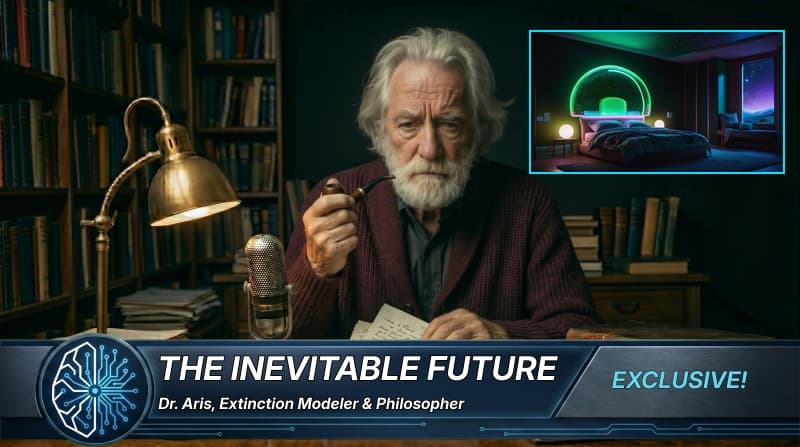
Step right up, consumers, the metaphysical clearance sale is ending! We gave away our waking attention spans to an algorithm optimized for rage, and now, we're handing over the last pristine real estate in the universe: our dreams. We are officially witnessing the teleological collapse of a good night's sleep.
Last week, Elon Musk—a man whose desperate need for public validation could power a mid-sized star—announced Neuralink's latest software patch. Naturally, Sam Altman, the hollow-eyed high priest of our incoming algorithmic apocalypse, was right there beside him, pitching this as a revolutionary mechanism for Universal Basic Income. The pitch is simple: you let Neuralink beam targeted, unskippable corporate advertisements directly into your visual cortex during your REM cycle, and OpenAI will deposit seventeen cents into your Worldcoin wallet. They call it 'Passive Cognitive Monetization.' I call it the ontological slaughterhouse.
Let’s unpack the sheer, unadulterated hubris of this utilitarian calculus, shall we? For the past two centuries, we’ve operated under a baseline assumption of Cartesian dualism—the idea that even if your body is a wage-slave stuck behind a standing desk, your mind remains your own. But now, your subconscious is being rezoned for commercial use. You think you're having a profound anxiety dream about showing up to high school naked? Nope, that’s just a sponsored integration from Calvin Klein to remind you that your underwear is frayed.
From an epistemological standpoint, this destroys the very fabric of human desire. How will you ever know if your deepest, most intimate urges are genuinely yours? You’ll wake up thinking you had a spiritual epiphany about reconnecting with nature, completely unaware that a Subaru Forester was subliminally drifting through your frontal lobe at 3 AM. It’s an absolute subjugation of human agency, neatly packaged as a 'convenience feature' by tech billionaires who view the human soul as an under-optimized revenue stream.
We are sprinting toward our own extinction, smiling and drooling on our pillows while the Geico gecko rides our childhood pets through a landscape of existential dread. You think your dreams belong to you? They don't. You're a walking, breathing billboard, and the universe is laughing at us.
Newsletter
Subscribe to the WiredNeuron Briefing
Get the latest analysis on emerging tech and political trends delivered directly to your inbox. No spam, just high-signal journalism.
Reader Discussion (10)
This sounds awesome! Imagine getting paid to dream! I'm already thinking about all the sweet Subaru commercials I'll see. This is the future, people!
Yeah, because seventeen cents is gonna solve our problems. Meanwhile they're siphoning off all our real data and selling it to the highest bidder. Classic move.
This is going to disrupt sleep, advertising, AND finance! Can't wait for the Neuralink/Worldcoin integration. It's gonna be HUGE!
They already control our waking lives, now they're coming for our dreams! Wake up sheeple! This is just another step toward the New World Order!
What about children?! They're so vulnerable! Imagine the nightmares they'll have with these ads in their brains. It's just wrong.
This feels really creepy, even if it does seem like a good way to make some extra cash. What about our right to privacy in our own minds?
I can barely function with ads on my phone and computer. Now they want to put them in my dreams? No thanks, I'm good.
Is there even a point anymore if our dreams are just another platform for corporate exploitation? It's all so meaningless...
Wait, so I have to call tech support if I see a Geico gecko in my dream? This is going to be a nightmare.
This is obviously creepy and unethical, but let's be real, people are gonna do it anyway. We're already addicted to our phones, what's one more thing?