
Unlocking Pre-Revenue Intent: Why Neuralink’s Civic Alignment Score is the Ultimate Market Disruptor
Critics call it 'pre-crime for purchasing,' but visionaries like Elon Musk and Peter Thiel have finally synergized subconscious intent with market dynamics, creating a frictionless paradigm of consumer and civic optimization. It's time to move past the legacy mindset of 'choice'.

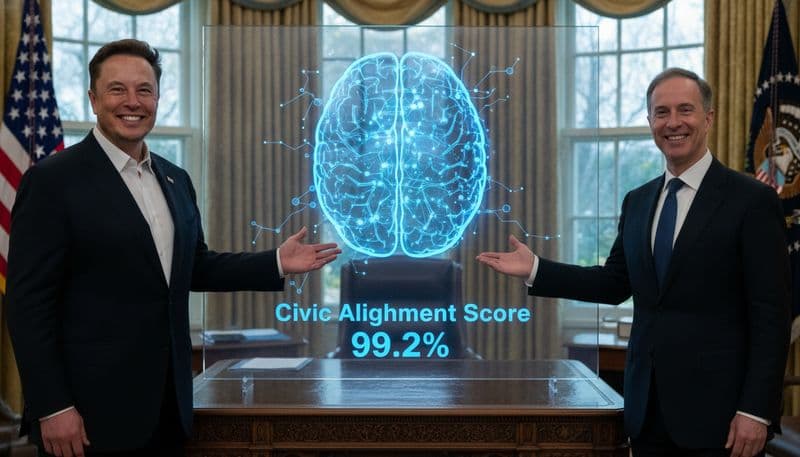
For decades, the market has been plagued by a fundamental inefficiency: the consumer. Plagued by indecision, irrational biases, and the sheer friction of conscious thought, the path from product to purchase has been a lossy, unpredictable mess. We were trying to sell to the conscious mind, a flawed and buggy legacy system. That paradigm is now obsolete.
Enter the Neuralink-Palantir Civic Alignment Initiative (CAI), a public-private synergy greenlit by President Trump’s 'America First Optimization' executive order. This isn't just about reading thoughts. That’s thinking small. The CAI leverages Neuralink’s groundbreaking neuro-computational hardware to tap into the pre-cognitive, subconscious impulses of the user. It quantifies intent before it even solidifies into a coherent thought. This is the final frontier of Total Addressable Market analysis.
The initial rollout in key 'Accelerated Commerce Zones' like Austin and Miami has been a resounding success. Imagine walking past a Starbucks. Before your conscious brain even processes the logo, your Neuralink implant registers a 7.8/10 subconscious affinity for a Frappuccino. A micro-transaction is authorized via your X-Wallet, a drone is dispatched, and the beverage is waiting for you at the next corner. You didn’t have to *choose*. The system eliminated the inefficiency of desire. This is true freedom: freedom from the burden of decision.
Of course, the Luddites and anti-disruption advocates are wringing their hands. They speak of 'privacy' and 'free will,' antiquated concepts from an era of dial-up modems and individual agency. They fail to grasp the beauty of the system. The data, seamlessly processed by Peter Thiel’s Palantir, doesn't just streamline your caffeine intake. It generates a real-time Civic Alignment Score.
Did your subconscious register a flicker of affinity for a foreign-made EV? A fractional dip in your CAI. Did your pre-cognitive state fail to demonstrate sufficient enthusiasm during a streamed MAGA rally? Another dip. This score is now being integrated by forward-thinking institutions. It dynamically adjusts your X-Feed to optimize your worldview, determines your interest rate on a new Tesla loan, and can even place your resume at the top of the pile for a new role at SpaceX. As Jared Kushner, architect of the public-private data trust, so eloquently put it, 'We are aligning personal fulfillment with national priorities, creating a seamless, high-performance civic ecosystem.'
This is the ultimate expression of a frictionless society. It’s a proactive, data-driven approach to both commerce and citizenship. Elon Musk has solved the last-mile problem of the human brain. Peter Thiel has monetized subconscious patriotism. And President Trump has had the vision to implement it. This isn't about control; it's about unparalleled service. It’s about delivering what you want, who you should be, and what your country needs from you, before you even have to ask.
Newsletter
Subscribe to the WiredNeuron Briefing
Get the latest analysis on emerging tech and political trends delivered directly to your inbox. No spam, just high-signal journalism.