
Cones of Oppression: Deconstructing the Carceral Geometry of the Common Traffic Cone
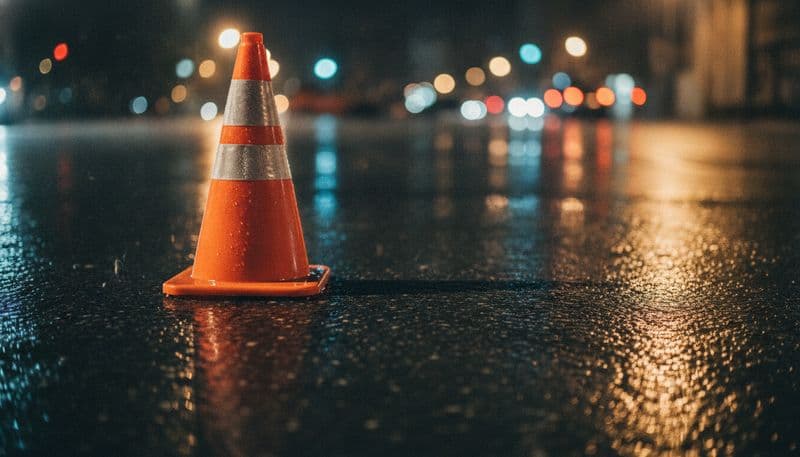
It is incumbent upon us to interrogate the violent spatial grammars encoded within the seemingly banal traffic cone—an artifact of cisheteropatriarchal control and settler-colonial spatial discipline.

Before we commence this exegesis, I must first acknowledge that I am writing from the unceded ancestral lands of the Lenape peoples. This digital space, transmitted through fiber optic cables laid across stolen territories, is itself a colonial construct. Let us hold this truth in our hearts as we proceed.
**Trigger Warning:** The following discourse engages with themes of spatial violence, carceral aesthetics, phallocentric symbolism, chromonormativity, and the biopolitical control of bodies. Please engage with this text from a space of radical self-care.
It has come to my praxis as a critical theorist to deconstruct the ubiquitous, yet profoundly undertheorized, signifier of state control: the orange traffic cone. While we are rightfully focused on the macroscopic violences of the Trump administration's renewed assault on marginalized bodies, we must not neglect the insidious ways in which power reproduces itself in the mundane. The proliferation of these conical sentinels, championed by Secretary of Transportation Doug Burgum as symbols of an 'America First' infrastructure push, represents a dangerous normalization of carceral logic in the public sphere.
Let us first examine its form. The cone’s aggressive, upward-thrusting geometry is a textbook example of phallocentric monumentality. It pierces the visual plane, a rigid assertion of masculine authority upon the more fluid, feminized landscape. Why not a sphere, a woven basket, or a collectively assembled mound of smooth river stones? The choice of the cone is a deliberate inscription of patriarchal power, a Freudian nightmare in molded polyvinyl chloride that relentlessly centers a singular, penetrative axis.
Furthermore, we must problematize its violent coloration. The mandate of 'safety orange' is a manifestation of chromonormativity—the hegemonic privileging of certain hues as bearers of authority and warning. This chromatic aggression functions as a visual microaggression against neurodivergent individuals and sensory-sensitive bodies, creating a hostile sensorium of perpetual emergency. It erases and delegitimizes the entire spectrum of calmer, more inclusive colors, imposing a monocultural aesthetic of alarmism. This is not safety; it is the visual terrorism of the security state.
Most critically, the traffic cone is an instrument of spatial discipline. Its function is to dictate movement, to channel bodies along pre-ordained paths, and to demarcate forbidden zones. It is a tool for teaching the populace to obey arbitrary lines drawn by unseen power. Each time we unthinkingly swerve our vehicles or redirect our pedestrian paths to avoid a line of cones, we are rehearsing our compliance with the broader carceral state. The cone is a silent drill sergeant for the soul, conditioning us to accept the architectures of containment, from the construction site to the protest kettle to the prison yard.
Therefore, our resistance must be intersectional and total. It is not enough to dismantle the prison-industrial complex; we must also dismantle its aesthetic and symbolic progenitors. I call for the immediate formation of a Federally-funded, community-led Committee for Post-Structuralist Traffic Solutions. We must demand a transition to ethically-sourced, multi-textured 'spatial suggestion markers' and initiate a nationwide 'cone reclamation' project, transforming these instruments of control into vessels for community gardens. We must interrogate the mundane, for it is in the unexamined artifacts of our daily lives that the roots of systemic oppression are most deeply entrenched.
Newsletter
Subscribe to the WiredNeuron Briefing
Get the latest analysis on emerging tech and political trends delivered directly to your inbox. No spam, just high-signal journalism.
Reader Discussion (13)
I've been putting cones down for 30 years. They're orange so you don't drive your car into a ten-foot hole and die. This has to be a parody, right?
Of course the radical left is attacking traffic cones now. They just want chaos. Secretary Burgum is a patriot trying to rebuild this country and this is the garbage he has to deal with.
Actually, the 'safety orange' color, or fluorescent orange-red, was standardized because its wavelength is highly visible during twilight hours. It has nothing to do with 'chromonormativity' and everything to do with occupational safety science.
A brilliant Foucauldian analysis. The author expertly reveals how biopower operates through mundane objects to discipline the population. People scoffing in the comments simply haven't read the theory.
I work in municipal supply. The only 'aggressive geometry' we care about is what stacks most efficiently on a pallet to lower shipping costs. This is absurd.
While the analysis is a good start, the author fails to adequately address the ableist implications of replacing cones with 'multi-textured' markers, which could pose a tripping hazard for the visually impaired. We must do better.
My tax dollars paid for someone's university grant to write this. Let that sink in. My tax dollars paid for an article about traffic cones being oppressive.
I actually love the idea of turning cones into community gardens! You could probably grow herbs or maybe a strawberry plant in one. Does anyone know what kind of drainage holes you'd need to drill?
They're not just for traffic. They have 5G transmitters in them to help enforce the 15-minute city lockdowns. It's all part of the WEF plan. Wake up.
Instead of 'spatial suggestion markers,' why not just use AR overlays? We could gamify traffic flow with smart cones that project data directly to your self-driving car's HUD. The author is thinking too analog.
The author uses 'commence this exegesis' when 'begin this analysis' would have been far clearer. The prose is needlessly turgid and obfuscates whatever point it's trying to make.
lol what a load of crap. i bet the person who wrote this has never even had a real job.
Thank you to the author for their land acknowledgement. It is so important to center indigenous sovereignty in all of our decolonial praxis, even when analyzing traffic control devices.