I Lived in the Metaverse for a Week and My AGI-Powered Takeaway is We Need to Bulldoze Yosemite for More GPUs
After a 168-hour immersion sprint, it's become algorithmically obvious: the physical world is legacy firmware with critical bugs and zero monetization. It's time to sunset this low-res simulation and reallocate underutilized assets—like national parks—to server farms for a high-fidelity, fully-optimized existence with lower latency.

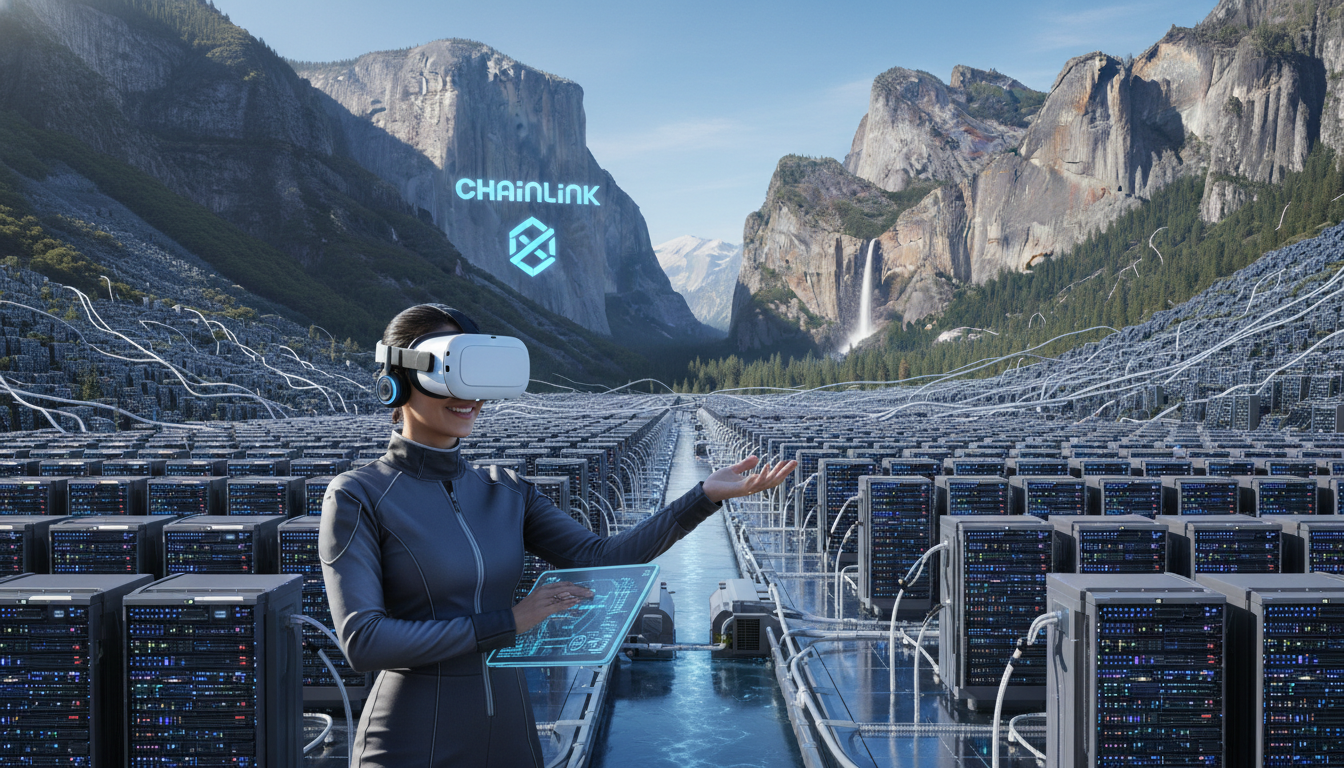
Look, I just spent 168 hours—a full sprint cycle—jacked into the Metaverse, and my entire personal OS has been upgraded. Coming back to what you luddites call 'reality' was a jarring UX downgrade. The graphics are poorly rendered, the haptics are inconsistent, and the entire system is plagued by inefficient, mandatory biological processes. You have to 'eat'? 'Sleep'? These aren't features; they're bugs in the Meatspace v1.0 spaghetti code. The whole platform is pre-alpha, and frankly, it's embarrassing we've put up with it for so long.
The physical world is a deeply flawed, poorly monetized simulation. The physics engine is arbitrary, the resource management is a joke, and there’s no clear roadmap or scalable business model. It's time for a pivot. A hard pivot.
I was flying a hyper-realistic X-wing through the Kessel Run in 8K at a buttery-smooth 240Hz when it hit me with the force of a Series A funding round: the only thing holding us back from true, scalable reality is a lack of processing power. The bottleneck isn't our ambition; it's our sentimental attachment to deprecated physical assets.
Which brings me to Yosemite. I've crunched the numbers. It's just a massive, inefficiently-allocated block of land. All those 'trees' and 'mountains'? They're just unprocessed polygons taking up valuable real estate with zero ROI. El Capitan is a glorified rock that can't even run Doom. We could bulldoze the whole valley, flatten it, and build the world's largest geothermal and solar-powered data center. We're not destroying a park; we're optimizing resource allocation for a V-Next reality. Think of the render speeds! Think of the reduced latency! We could finally achieve photorealistic, persistent worlds for every user on the planet.
I can already hear the legacy users whining about 'nature' and 'biodiversity.' It's a classic failure to disrupt. They're attached to an obsolete feature set. They’re the same people who probably still use a 1080p monitor and think 'ethernet' is a type of gas. Empathy for nostalgic attachment to flawed systems is an inefficiency we can no longer afford. The future isn't about touching grass; it's about rendering it in real-time with ray tracing so realistic you can feel the individual photons on your virtual skin. It's time to log off from this buggy beta and onboard humanity to the gold master of existence.
Reader Discussion (13)
This is a fun thought experiment, but the author completely ignores the political capital and regulatory hurdles. A project of this scale would be tied up in litigation for decades before the first shovel hits the ground.
The author's claim that El Capitan can't run Doom is technically false. Given sufficient power input and a large enough display array, it could serve as a non-interactive backplate. The premise is flawed.
I've been in this industry for 25 years. We see an article like this every 5-7 years during a new hype cycle. It was virtual worlds in the 90s, Second Life in the 2000s, and now this.
This is the kind of disruptive, blue-sky thinking we need to unlock next-gen value streams. It's about reframing our perspective on legacy assets to enable digital transformation at scale.
I'm just trying to get our CI/CD pipeline to stop failing on a Tuesday and this guy is out here architecting the heat death of the universe. Must be nice to have that much free time.
He's not wrong about the GPU bottleneck. I don't care about his metaverse nonsense, but if bulldozing a park means I can get a 5090 Ti for under MSRP, where do I sign?
Even with geothermal and solar, the water usage for cooling a facility that size would be catastrophic for the local ecosystem. The PUE would have to be near a theoretical 1.0 to even begin to be justifiable.
The NPV of Yosemite is basically zero unless you count tourism, which is a low-margin services business. Converting an underutilized physical asset into a high-yield digital infrastructure hub is just logical capital allocation.
Comparing 'reality' to a user interface shows a fundamental misunderstanding of embodied cognition. The so-called 'bugs' like sleeping and eating are core system requirements, not UX flaws.
Is this article real? I took my kids to Yosemite last summer. You want to bulldoze it for a computer?
GPUs are a brute-force solution. For a persistent world, you'd want to offload physics and AI calculations to dedicated ASICs or FPGAs. This whole plan is incredibly inefficient from a silicon perspective.
While the proposal is extreme, the author touches on a key point about the limitations of our biological substrate. We shouldn't be afraid to discuss radical solutions for humanity's next evolutionary step.
Forget the bulldozing, let's talk logistics. The sheer amount of concrete needed would be a nightmare. And have you thought about the network backbone you'd have to run through the Sierra Nevadas?