
Andreessen Horowitz Disrupts Congress, Acquires House Science Committee in Pivot to 'GovTech 3.0'
In a landmark M&A deal for democracy, venture capital giant Andreessen Horowitz has successfully acquired a controlling interest in the House Committee on Science, Space, and Technology, replacing its legacy debate protocols with a new, blockchain-verified legislative throughput engine called 'LegislateOS'.

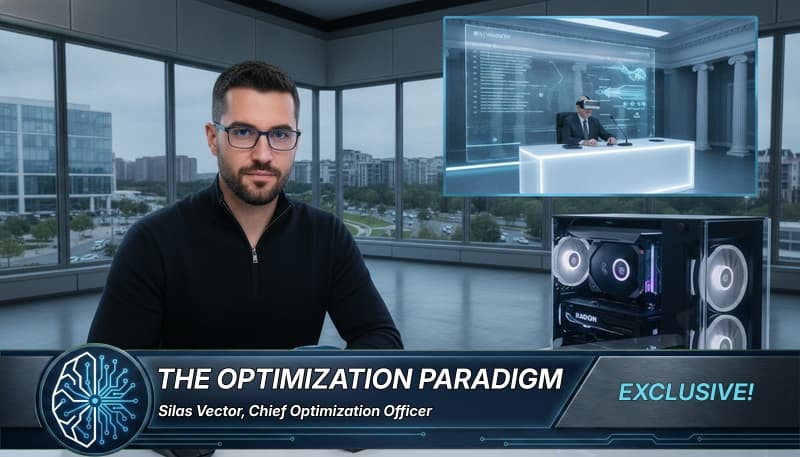
Finally. The legacy meatspace of Washington D.C., a bloated server running on deprecated code, is getting the patch it so desperately needs. It’s a classic case of a non-technical founder running a product into the ground. For centuries, our government has operated on an OS riddled with bugs like ‘bipartisanship,’ ‘deliberation,’ and ‘human emotion.’ These aren't features; they're critical vulnerabilities that introduce unacceptable latency into the system. The throughput is abysmal. You people are trying to run a nation on hardware that belongs in a museum. It's frankly embarrassing.
Enter the A-team. This week, my colleagues at Andreessen Horowitz (a16z) announced a pivotal Series A investment—or, in legacy terms, a complete operational takeover—of the U.S. House Committee on Science, Space, and Technology. This isn't just funding; it's a full-stack restructuring. We’re sunsetting the entire archaic framework of hearings, testimony, and voting. Why would you rely on vocalized data streams from wetware sources when you can have direct API integration with key stakeholders?
The committee, now a wholly-owned subsidiary of the a16z Growth Fund, will be managed by a lean, agile pod of product managers. Chairman Frank Lucas has been retained, but his new title is 'Legacy Integration Specialist.' His role is primarily to interface with the other, un-optimized legacy nodes in the Capitol Hill network.
The core of the upgrade is 'LegislateOS,' a proprietary platform developed in-house. It leverages a generative adversarial network to draft all legislation, A/B testing policy points on targeted demographics in real-time to maximize approval metrics. Voting is no longer a circus of raised hands and guttural noises; it's a frictionless transaction on a private, permissioned blockchain. Every 'Yea' or 'Nay' is a smart contract executed with cryptographic certainty. We've replaced the filibuster, which is basically a human-level denial-of-service attack, with a rate-limiter. Debates are now asynchronous, conducted entirely via pull requests on a private code repository.
Naturally, the luddites who are still running their lives on last-gen iPhones are wringing their hands about 'ethics' and 'corporate control.' This is FUD from low-information users who don't understand scale. Democracy isn't a feeling; it's a data-processing problem. A16z General Partner Marc Andreessen articulated it perfectly in the press release: 'We are simply applying proven hyper-growth methodologies to a severely underperforming vertical. Our goal is to 100x legislative output by Q4, achieving a frictionless governance paradigm that delivers superior value to all shareholders—uh, I mean, citizens.'
This is the beta test. Once we've optimized the Science Committee, we plan to scale the solution horizontally across the entire federal apparatus. The Department of Justice is next. Think of the efficiency gains when you replace due process with a predictive algorithm. This is the future. It’s streamlined, it’s scalable, and it’s inevitable. Anyone who disagrees is probably still using a mechanical keyboard. Upgrade your stack.
Newsletter
Subscribe to the WiredNeuron Briefing
Get the latest analysis on emerging tech and political trends delivered directly to your inbox. No spam, just high-signal journalism.